Development flow¶

This page is the one place the whole loop is written down, and it holds in every repo. The pieces
live in the /marola-devkit:mip and /marola-devkit:mip-tasks skills, AGENTS.md (the hard
rules), AGENT-SKILLS (which skill does what) and the devkit's
tools (stack, uprd,
issues, cost-split, …, on PATH inside nix develop). MIPs and their task files live in the
umbrella's docs/MIPs/; the code they change lives in the repo each task names. A change that
spans repos also follows WORKING-ACROSS-REPOS.
Sessions: one per MIP for planning, one per task for execution (/clear, /rename
mip-nnnn/k-slug), one per review. That is what makes /usage and just claude-cost (umbrella) map
to PRs.
1. From an idea to an issue, then a MIP (Draft)¶
- File the issue first — the idea is not work until it is one, and the tier decides what
follows: tier 1 (bug, chore, docs) and tier 2 (small enhancement, the issue body is the spec)
stop here and go straight to §4; only tier 3 (a new data source, a scoring change, a new
integration, anything paid) continues into a MIP, as a MIP proposal issue that is relabelled
rather than replaced when the MIP PR opens. Filing is a human's act: the
/marola-devkit:triageskill drafts the body and runs the readiness check, a person presses the button (ISSUE-FLOW, MIP-0063 §5.6). An agent picks work up fromjust issue-queueand takes it withjust issue-claim <n>; it may not start on an issue withoutagent-ready. - Refine the idea: superpowers
brainstorming(activates on "let's plan", "I have an idea"): Socratic questions until MIP §1-§3 (summary, motivation, user-visible change) have answers. Voice notes and chat pastes go throughjust context-mips+ a browser session first (below). - Write the MIP: the
/marola-devkit:mipskill: next number fromdocs/MIPs/README.md, the template, every external claim fetched and dated, what was not checked said so, open questions listed. Add the index row. Link it from FUTURE-WORK if it closes something. - Open it as its own PR, status Draft. A MIP is never built in the same change (
mipskill, step 8). The PR body ends with aCost:line like any other.
Voice notes into MIPs in a browser session¶
just context-mips packs what a MIP author needs, and no code, with repomix into
.tmp/marola-context-mips.md and copies it to the clipboard: the README, AGENTS.md, marola-app's
README (so run git submodule update --init first), ARCHITECTURE, PHASES, FUTURE-WORK, the
/marola-devkit:mip skill and every existing MIP. In a browser Claude chat, paste it, attach the
WhatsApp voice notes (.ogg) or the chat text, and say "convert the audios into MIP proposals".
The pack's instruction section (repomix-instruction.md) fixes the template, the numbering, the
transcript appendix and the rule that unverified claims go under "Open questions". Save the
returned files under docs/MIPs/ and let the in-repo agent verify the sources.
2. Acceptance¶
Acceptance is a human decision, recorded in the MIP's status table and the index. The reviewer of a MIP PR reads, in this order:
- §4 sources and dependencies: was each claim verified (URL + date)? Anything unverified must sit in §11, not in §5.
- §6 scoring / safety: deterministic, in marola-app's
scoringpackage, unit-tested; never model output. Phase row againstAGENTS.md's phase discipline: a later-phase MIP is fine to accept, but the missing earlier-phase prerequisite must be named. - §8 caveats and §11 open questions: answer what can be answered now; what cannot becomes a numbered decision in the tasks file (next section), so implementation is never blocked on it.
- Cost: the MIP's own cost model (§4/§8) and whether any paid resource is involved
(
AGENTS.md: a paid cloud resource needs an explicit go-ahead, in the MIP, before any task).
Outcome: Accepted (status row + docs/MIPs/README.md, in the MIP PR or a one-line follow-up
commit), Rejected (keep the file; the reasoning is the value) or Superseded by MIP-NNNN.
"Implement MIP-NNNN" from the human counts as acceptance; the first task's commit flips the
status to Accepted and links the tasks file.
The status row's own lifecycle:

3. The task list¶
mip-tasks step 1 (superpowers writing-plans is skipped: the MIP is the plan): read the MIP,
AGENTS.md and the code it touches, write docs/MIPs/MIP-NNNN.tasks.md:
- one row per task = one PR in one repo (its
deliverscell): ≤ ~400 changed lines, one concern, its test named up front (from MIP §7), green on that repo's gates by itself; - ordered by dependency, then risk; docs travel with the task that changes behaviour;
- a Decisions list answering the MIP's §11 for v1, so nothing is re-litigated per task;
- a restack note: no task rewrites a file an earlier task created.
The tasks file is committed in the umbrella; the MIP gets a Tasks: row. Project it into
GitHub with just tasks-to-issues MIP-NNNN: a parent issue in the umbrella, one sub-issue per row
in the repo that row delivers to, each row's # cell rewritten into a link, one native
blocked by edge per depends on entry. One-way and re-runnable — after it, the issues own
status and the file owns the plan.
4. Stacked PRs — one task, one branch, one PR¶
Per task, in its own session, started in the repo the task delivers to (superpowers
executing-plans: the task row is the plan; checkpoints = first failing test, before push). In a
submodule, branch from that repo's origin/main
(WORKING-ACROSS-REPOS):
stack start MIP-NNNN <k> <slug>        # branch mip-nnnn/k-slug off the nearest lower task branch in this repo, else origin/main
# red → green → refactor  (superpowers test-driven-development; systematic-debugging when green won't come)
just quality                                       # the repo's gates (its AGENTS.md names them) + a live check whenever a data path changed (superpowers verification-before-completion: evidence, then the claim)
git commit                                         # message ends with Tested: and Cost: trailers (AGENTS.md) — the PR's Tested/Cost sections come from them
just pr                                            # fills any missing trailer and a task's Closes line (just cost-fill), pushes, opens/updates the PR — stack pr's base logic on a mip-NNNN/k-* branch
The git history this produces — two stacked tasks, squash-merged bottom-up, then restacked:
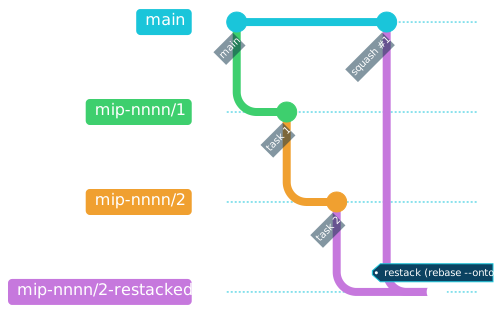
just pr --dry-run prints every step (the trailers cost-fill would add, the body uprd would
write) without pushing or touching gh. It refuses the same way the real run would (on main, or a
dirty tree) so the preview matches what actually happens.
Every push (stack pr, just uprds, a plain git push) goes through the devkit's pre-push
hook, which runs the repo's just prepush: the gates CI would fail the push on (here
just quality-other; each repo's AGENTS.md names its own). Code is linted before the last push,
not found red in CI after the merge; git push --no-verify skips the hook, CI does not.
Or, once every branch of the stack is pushed, all PRs at once with their shared "Stack" section:
just uprds MIP-NNNN         # regenerate every PR body (What changed + Cost + Stack), create the missing PRs on the right base
just stack-link MIP-NNNN    # link the open PRs into a GitHub Stack (gh stack link) — the "Preview stack" box in the PR UI, from the CLI
just stack-view             # the stack as GitHub sees it; just stack status MIP-NNNN for the local view
What GitHub shows: a stacked PR is a PR whose base is the previous branch; its page says "into
mip-nnnn/1-… from mip-nnnn/2-…" and its diff is that task alone. The Stack (native GitHub
feature, gh stack) adds the ordered list at the top of each PR; just uprds writes the same list
at the end of each body, with the summed Cost, for readers without the feature.
A PR opened any other way (the GitHub UI's "Compare & pull request", a bare gh pr create) gets
the same body without anyone running just uprd: .github/workflows/pr-body.yml runs
uprd <PR#> when the PR is opened, reopened, marked ready, or gets new commits, as long
as the body is empty, still the raw template, or carries uprd's own first-line marker (a
hand-written body is left alone; delete the marker line to stop regeneration). It also replaces a
title that is still the branch name with the first commit's subject. Forks and bot PRs are skipped.
The generated body follows .github/PULL_REQUEST_TEMPLATE.md's shape: bold labels, a compact
MIP/Tested/Cost table, no # headings, one screen for a typical two-commit PR; the PR title is the
first commit's subject on the branch, capped at 70 characters (the devkit's
scripts/lib/uprd_title.sh)
so it stays skimmable. just uprd/just uprds print a warning when a title had to be cut, worth a
manual retitle if the cut reads awkwardly.
Cost: a measured figure is always preferred over an estimate. One session per task → /usage or
just claude-cost (umbrella). One session for several tasks → just cost-split MIP-NNNN splits the
session log by commit time (subagent transcripts included: <session>/subagents/*.jsonl) and prints
the trailer per branch; amend with GIT_COMMITTER_DATE preserved so the split stays stable,
re-stack, force-push with lease, just uprds. Nothing logged at all for a commit (a subagent whose
worktree session never re-attached, a commit from another machine) → just cost-fill (or plain
just pr) adds cost-split --estimate's diff-size estimate instead, always labelled est. so it
reads differently from a measured number at a glance.
5. Final review — only when asked¶
Nothing reviews a PR automatically. (Proposed change:
MIP-0060, an advisory local-model pass when a PR is
marked ready.) Reviews start when the human says so ("review the stack", "claude review #21",
/code-review). Three ways, cheapest first; all of them review one PR against its own base,
bottom of the stack first, because that is the diff a reviewer sees.
- superpowers
requesting-code-review: in a fresh session, per PR: dispatch the reviewer subagent withBASE_SHA = git rev-parse origin/<base branch>,HEAD_SHA = git rev-parse origin/<task branch>,PLAN_OR_REQUIREMENTS= the task's row inMIP-NNNN.tasks.mdplus the MIP's §6/§7,DESCRIPTION= the PR title. It returns Critical/Important/Minor findings; fix Critical and Important before merging, note Minor in the PR. This is the default for "final review using superpowers". /code-review <PR#>(built-in;--commentposts the findings as inline PR comments) or thecode-reviewplugin's/code-review(five parallel agents, ≥ 80-confidence findings only, one comment on the PR). Both look forCLAUDE.md; in every marola repo it importsAGENTS.mdfor Claude Code sessions and tells any tool reading it as plain text to openAGENTS.md. The plugin's confidence scorer only credits rules it can read, so keep that instruction there./code-review ultra <PR#>: the multi-agent cloud review, for the riskiest PR of a stack (scoring, safety text, a new data source). User-triggered and billed; never launched by the agent./gemini reviewas a PR comment, in a repo that installed Gemini Code Assist on GitHub (marola-app: its code review setup). Free, advisory, on request only, and skips.github/workflows/**by design. Source goes to Google, so a human installs it, never an agent. GEMINI-CODE-ASSIST is the evaluation.
Author side: superpowers receiving-code-review: verify each finding before implementing it,
push back with reasoning when it is wrong, then fix → commit (Cost: trailer) → push → just
uprds MIP-NNNN. Pre-review checklist (superpowers requesting-code-review + this repo): Cost
line present and measured; docs updated in the same PR; the test named in the tasks row exists and
is green; MIP status right.
6. Merge, restack, finish¶
- Approve per PR (GitHub reviews are per PR), then merge either one at a time or the whole stack
at once:
gh
stack merge <stack#> --squash
merges every PR of the stack bottom-up in one all-or-nothing operation (gh stack merge), no restack in between. - One at a time: bottom-up, squash (the repo's habit). GitHub retargets the next PR to
mainwhen the merged branch is deleted; the commits still need a rebase:stack restackon the next branch, orjust stack-sync MIP-NNNNfor the whole stack (it adopts the stack from GitHub first;gh stack linkkeeps no local state). - A task branch's own commit carries
Closes #Nfor the issue itsMIP-NNNN.tasks.mdrow links (cost-fill, run bystack pr— itself run byjust pr, or directly per step 2 of/marola-devkit:mip-tasks— writes it above the trailers), so the squash-merge commit onmaincloses the issue and the board moves it to Done. The PR body carries the same line too (uprdcopies it there so the link shows on GitHub), but the body-only line does not close the issue; the commit-body one does.TASK_PARTIAL=1 just prskips the line for a task that only delivers part of its row, before the PR (and itstask-partiallabel) exist; the issue stays open. A PR merged into another task branch closes nothing regardless; GitHub honours the keyword only on the default branch. stack status/just stack-viewuntil every PR is merged.- Last merge: superpowers
finishing-a-development-branch: full suite green, delete the task branches, flip the MIP to Implemented with the PR numbers and the summed Cost in its status row, updatedocs/MIPs/README.md. A follow-up after a merge is a new branch offmain, never a child of the old one. Across repos, the umbrella's pointers then move through the sync PR (WORKING-ACROSS-REPOS).
Dependency PRs¶
dependabot (each repo's .github/dependabot.yml) and, in marola-app, scala-steward (its
.github/workflows/scala-steward.yml) each open their own one-off PR per bump. Left alone, ten open
bumps cost ten separate CI runs to land. just deps-stack chains the open dependabot PRs
(--include-steward adds scala-steward's, once its author identity on marola-app is confirmed; see
deps-stack's header) into one deps/<date>/k-slug stack, github-actions PRs first then pip, same
shape as a MIP's task branches: run it weekly, or right before a release, rather than merging bumps
one at a time. A PR's head branch can't be moved after it's opened, so the default (and only
implemented) path opens one new PR per chain branch, stacked on the previous, and closes each
original dependabot PR with a pointer comment. dependabot's own branches are never touched, so an
abandoned stack doesn't stop dependabot from re-opening or updating them normally. The whole chain
is built in a dedicated worktree, .tmp/wt-deps-stack, never your own checkout: a run of just
deps-stack (status, clean, --resume, or a conflict mid-run included) never switches your
branch or touches your index. Two dependency bumps landing on adjacent lines of the same file (the
only conflict shape dependabot produces) resolve themselves: *requirements*.txt keeps the higher
lower bound per package (the devkit's
scripts/lib/req_merge.py),
a workflow's uses: owner/action@vN steps keep the higher version per action
(scripts/lib/uses_merge.py,
the actions/checkout@v7-next-to-hadolint-action@v3.5.0 case); anything else still stops the
script with the branch left mid-cherry-pick in that worktree and prints the exact cd
.tmp/wt-deps-stack && git status / resolve / git cherry-pick --continue / just deps-stack
--resume steps. Once the chain is up, it's a normal stack: gh stack link runs automatically, gh
stack merge <stack#> --squash merges it bottom-up in one CI run instead of one-per-bump, and just
deps-stack clean deletes the chain branches (and the worktree) once every stacked PR shows MERGED.
MIP draft PRs¶
Drafts pile up the same way bumps do: one docs/mip-NNNN-* branch per proposal, each open for days,
and they fight over one line: every draft appends its row to docs/MIPs/README.md at the same
place, so the moment one merges the rest conflict there. just mip-stack chains the open draft PRs
(any PR whose head is docs/mip-* or that adds a docs/MIPs/MIP-NNNN-*.md; task branches
mip-NNNN/k-* are left to stack) into one mips/<date>/k-slug stack ordered by MIP number, the
exact shape just deps-stack gives dependabot: built in its own worktree (.tmp/wt-mip-stack), one
new PR per chain branch stacked on the previous, the original PR closed with a pointer, gh stack
link at the end, just mip-stack status / clean / --resume / --skip / --dry-run as for
deps. The index-row conflict resolves itself (the devkit's
scripts/lib/mip_index_merge.py:
both sides' rows, one per MIP, in number order; the same row edited differently on both sides is a
real edit and stops for a human). A draft that merged another draft's branch to stay mergeable is
fine: merge commits are skipped and commits the chain already carries are dropped by patch-id. Then
gh stack merge <stack#> --squash lands the lot bottom-up.
7. Overnight/unattended runs¶
/marola-devkit:mip-solve-perpetual works through a task file unattended. Its mechanics, the usage
guard (and what the heavy-usage plugin can and cannot stop) and the stop conditions are on the
devkit's
runners
page; the skill itself is on its
plugin page. Merging stays a
human act: every repo's .claude/settings.json should deny gh pr merge, gh pr close, gh stack
merge, gh stack unstack and gh stack delete; check it before a run.
8. The docs site¶
Moved to DOCS-SITE.md: what the build mounts where, the landing and link rules, the per-repo skeleton and ADRs, redirects, the checks, preview and deploy.
9. Command reference¶
Every devkit tool and recipe used above (PRs and stacks, cost and trailers, issues and the board,
labels and rulesets) is on the devkit's
tools page. Each repo's gates
are in its AGENTS.md and its 3-development page, the umbrella's recipes are just --list
here, and which checkout a recipe needs is in
WORKING-ACROSS-REPOS.